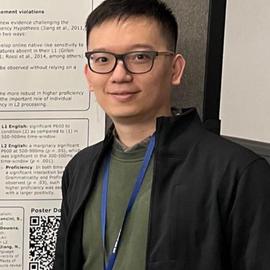
Welcome!
I am currently a Ph.D. candidate in Linguistics in the Linguistics Department at the University of Kansas, under the supervision of Dr. Fiorentino, Dr. Gabriele, Dr. Minai, and Dr. Politzer-Ahles.
My research advances three strands: (1) Neurolinguistics & Cognitive Neuroscience of Language, examining how the brain represents and processes first and second language in real time; (2) Language Development, investigating how typically developing children, children with language disorders, and bilingual learners acquire abstract linguistic knowledge; and (3) Computational Linguistics, using NLP and large language models to model input statistics and predict learning and processing difficulty.
In my research, I combine EEG/ERP, behavioral method (eye-tracking), corpus-based analyses and computational approaches.
Download my CV.
- Neurolinguistics
- Language Acquisition
- Language Disorders
- Computational Linguistics
-
PhD in Linguistics, June 2026 (Expected)
University of Kansas, Kansas, U.S.
-
MS in Computer Science, June 2026 (Expected)
Georgia Institute of Technology
-
MA Linguistics, 2021
Syracuse University, New York, U.S.
-
MA Applied Linguistics, 2018
Universitat de Barcelona, Barcelona, Spain.
News
- 🎉 I received a competitive grant from Language Learning to support my EEG study on individual differences in L2 sentence processing!
- 🎉 Our paper on a machine-in-the-loop approach to analyzing discourse in a large online education program was accepted to SIGCSE ’26 (with Erik Gok, Dr Joyner, and Dr. Rusch).
- 🎉 My paper titled ‘Maternal Input Quality and Early Language Outcomes in Late Talkers: A Longitudinal Analysis of Lexical and Syntactic Development’ was accepted to present at Boston University Conference on Language Development in November 2025, and receives the Paula Menyuk Award and Student Travel Award.
- 🎉 My paper titled ‘Investigating sensitivity to binding constraints in L1 and L2 English using event-related potentials’ was presented at 2025 Society for the Neurobiology of Language Meeting at the Gallaudet University, DC.
Research
🧠 Neurolinguistics & Language Processing
I examine how the brain represents and processes words and sentences in real time in L1 and L2, and how linguistic factors (e.g., cross-linguistic influence) and individual differences in cognitive abilities (e.g., working memory, verbal abilities) modulate real-time language comprehension.
Selected Publications & Presentations
- Wang, X., Fiorentino, R., & Gabriele, A. (under review). Examining individual differences in the processing of long-distance dependencies in L1 and L2 English. Submitted to Language Learning.
- Wang, X., Gabriele, A., & Fiorentino, R. (2025). Investigating sensitivity to binding constraints in L1 and L2 English using ERPs. Poster presented at the Society for the Neurobiology of Language Meeting (SNL 2025), September 12–14, 2025.
- Wang, X., Gabriele, A., & Fiorentino, R. (2025). Examining sensitivity to subject-verb agreement in a second language (L2): An ERP investigation. Poster presented at the Cognitive Neuroscience Society meeting, March 29–April 1, 2025.
👶 Developmental Psycholinguistics
This strand investigates how typical and atypical learners, including bilingual children and children with language disorders, acquire abstract grammatical and semantic knowledge, and how language experience and cognitive resources affect developmental trajectories.
Selected Publications & Presentations
- Wang, X., & Minai, U. (under review). Children’s use of discourse cues to resolve ambiguity: A case study on Mandarin-speaking children’s comprehension of ambiguous wh-adjuncts. Submitted to First Language.
- Wang, X., McMillen, S., & Shi, Y. (2025). The roles of L1 transfer, L2 exposure, and morphological salience in bilingual children’s morpheme development. Frontiers in Psychology, 16. https://doi.org/10.3389/fpsyg.2025.1566442
- Wang, X., & Shi, Y. (2025). Examining mother-child interaction input quality and its impact on late talkers’ lexical and syntactic development. Poster presented at the Cognitive Science 2025, July 30–August 2, 2025.
🤖 Computational and Educational Approach to Language
I integrate NLP and LLM-based analyses to analyze discourse and text use. I also conduct studies that translate linguistics and psychology research into educational practice.
Selected Publications & Presentations
- Gok, E., Wang, X., Joyner, D., & Rusch, A. (accepted). Examining discourse in a large online education program: A machine-in-the-loop approach. In Proceedings of the 57th ACM Technical Symposium on Computer Science Education (SIGCSE ’26). ACM.
- Gok, E., Wang, X., Joyner, D., & Rusch, A. (2025). Public perceptions and communications of a large online graduate program. In Proceedings of the 2025 IEEE Digital Education and MOOCs Conference (DEMOcon). IEEE.
- Wang, X., & Tragant, E. (2022). The effect of written text on comprehension of spoken English as a foreign language: A replication study. International Review of Applied Linguistics in Language Teaching, 60(3), 625–645. https://doi.org/10.1515/iral-2018-0350
Teaching
I have taught a diverse range of courses at the college level in the United States across in-person, online, and hybrid formats. During my graduate study at Syracuse University, I worked as an instructor of Chinese for two years. At the University of Kansas, I have been working both as a Graduate Teaching Assistant and as the instructor of record for linguistics courses. I have also delivered guest lectures in First-Year Seminar on Language, Thought and Culture and Neurolinguistics I.
Across these experiences, I have shaped my teaching philosophy that is student-centered and is focused on creating environments that allow all students to participate and to develop skills to become independent thinkers and researchers.
Linguistics
-
Guest Lecturer LING 111: Language and Mind (honors)
-
Guest Lecturer LING 435: Neurolinguistics
-
Guest Lecturer First Year Seminar on Language, Thought and Culture
-
GTA LING 325: Syntax, with Dr. Gluckman
-
GTA/Instructor of Record LING 110: Language and Mind with Dr. Politzer-Ahles
-
GTA/Instructor of Record LING 320: Language in Culture & Society with Dr. Duncan
Mandarin Chinese
-
Instructor of Record CHI 101: Introductory Chinese I.
-
Instructor of Record CHI 102: Introductory Chinese II.
-
Instructor of Record CHI 200: Daily Conversation in Chinese.
Skills
Contact
- xuan.wang@ku.edu
- Department of Linguistics, University of Kansas, Lawrence, Kansas, U.S.
- Blake Hall–Office 419
- Mondays/Wednesdays 9:45 to 10:45
- Message Me